Gulf tensions escalate as U.S.-Iran naval confrontation intensifies; Ukraine faces renewed Russian offensive
Key developments
- U.S. strikes on Iranian oil tankers and Iran's claimed capture of an advanced American underwater drone mark escalating Persian Gulf naval confrontation.
- Houthi forces sustained multi-day ballistic missile and drone campaigns against Saudi Arabian energy facilities, inflicting 73 reported casualties and infrastructure damage.
- UK, France, Canada, and nine other nations announced coordinated sanctions on Israeli settlements; U.S. rejected participation, widening Western fractures.
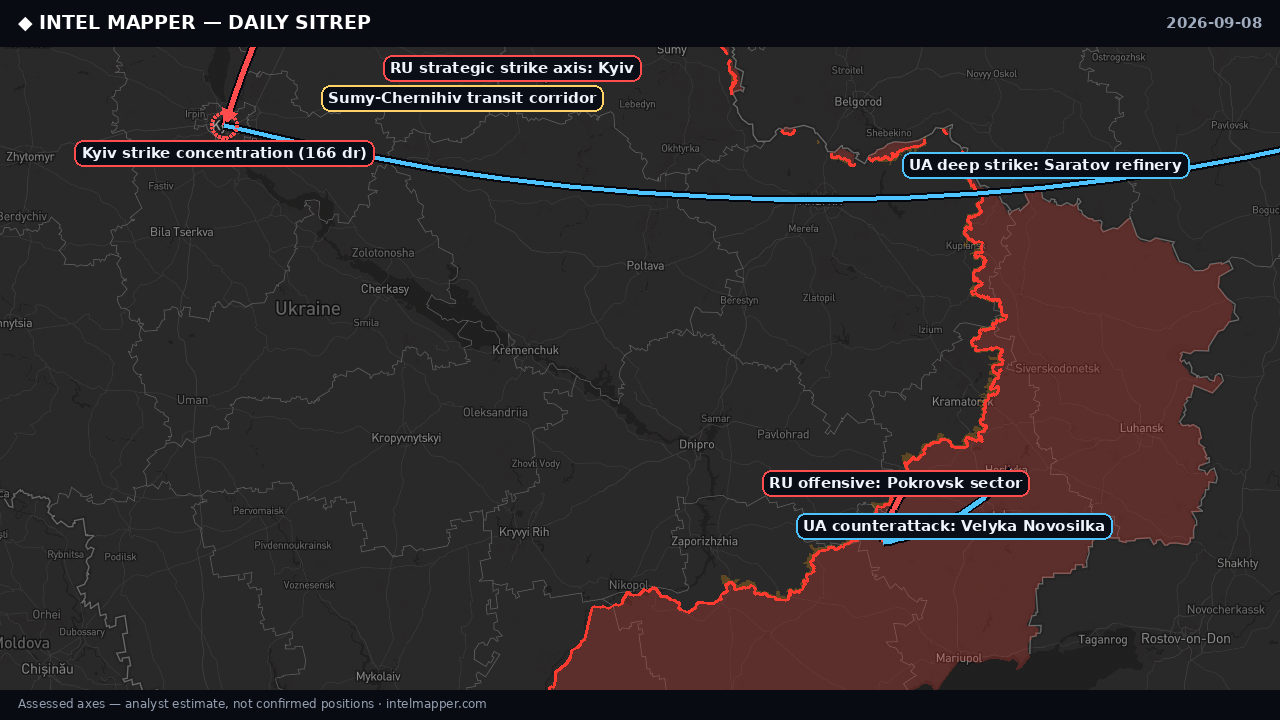
- Russia resumed major air and missile offensive against Kyiv after three-day pause, launching 166 drones and dozens of missiles with 244 combat clashes reported across Ukrainian fronts.
- UK and Germany announced new winter air defense packages for Ukraine; Ukraine unveiled domestically-built Koral missile system.
- UN Commission of Inquiry alleged Israeli military operations in southern Syria may constitute war crimes, citing detention of 49 Syrian civilians.
- Western assessments project Russia's Ukraine war continuing into 2027, with Putin unlikely to negotiate seriously before 2026.
Middle East 30 tracked events
Escalating U.S.-Iran military operations in the Persian Gulf marked the operational focus of the day. Iranian media reported a U.S. strike on an Iranian oil tanker near Kharg Island, aligning with established U.S. policy targeting Iranian crude exports. Separately, Iran's IRGC Navy reportedly captured an intact Anduril Dive-LD autonomous underwater drone (~$2.5M unit) in the Strait of Hormuz and claimed interception of a U.S. MQ-1 Predator drone, with footage reportedly confirming the shootdown. Iranian military commanders warned that any further attacks on tankers would trigger Iranian Armed Forces strikes on U.S. regional bases. These incidents reflect deepening naval confrontation over energy infrastructure and surveillance assets, with both sides demonstrating willingness to engage directly.
Houthi forces conducted sustained ballistic missile and drone campaigns against Saudi Arabia across multiple days, striking energy facilities and civilian infrastructure in the Asir, Jizan, and Abha regions following 121 Saudi airstrikes. Saudi authorities reported 73 injured and fires at multiple energy sites, including temporary operational shutdowns. Russia's Foreign Minister Lavrov stated Houthi strikes would backfire while reaffirming Moscow's support for Saudi Arabia's peace roadmap in Yemen. Turkey condemned the attacks as destabilizing and threatening civilian lives. These operations underscore persistent Houthi capability to conduct sustained strikes despite Saudi-led coalition air superiority, sustained by Tehran's logistical support.
Diplomatic fractures widened over Israeli settlement policy and regional security. The UK Foreign Secretary accused Israeli settlers and government of ethnic cleansing in the West Bank, while twelve nations—including France, Canada, and UK—announced coordinated restrictions on settlement goods, circumventing EU deadlock. The U.S. State Department rejected these sanctions, stating opposition to destabilizing measures. A UN Commission of Inquiry alleged Israeli military operations in southern Syria may constitute war crimes, citing detention of 49 Syrian civilians including children. Turkey supported the settlement sanctions initiative. These divergences reflect persistent disagreement among Western allies regarding Israeli conduct in occupied territories and Syria.
- Iranian media reports U.S. strike on Iranian oil tanker near Kharg Island in the Persian Gulf. Aligns with ear
- UK Foreign Secretary Ed Miliband accuses Israeli settlers and government of ethnic cleansing in occupied West
- Houthis launched dozens of ballistic missiles and drones at Aramco facilities and military targets across sout
- IRGC spokesperson claims capture of advanced U.S. unmanned submarine (Anduril Dive-LD) in Strait of Hormuz, bo
- Iranian air defenses successfully intercepted and destroyed a U.S. MQ-1 Predator drone over the Strait of Horm
- UN Commission of Inquiry warned that Israel's military operations in southern Syria—including raids, incursion
Ukraine 30 tracked events
Russian air and missile operations against Ukraine resumed at scale after a three-day pause coinciding with U.S. envoys' visit. Russia launched 166 drones and dozens of missiles at Kyiv overnight, with confirmed ballistic missile impacts documented on video. Ukrainian General Staff reported 244 combat clashes across fronts, 99 Russian airstrikes, 285 guided bombs, and 8,495 kamikaze drones deployed on 8 September alone. Ukrainian forces conducted successful counterattacks southwest of Kostyantynivka, inflicting damage to Russian flank positions. These metrics demonstrate sustained Russian operational tempo and Ukrainian tactical responses, with no indication of deescalation.
Western military aid to Ukraine accelerated in response to intensified Russian operations. The UK pledged £100 million in winter air defense packages including Patriot interceptors and large-caliber artillery. Germany announced PAC-2 Patriot interceptors, AIM-9 missiles from Bundeswehr stocks, and tens of thousands of long-range artillery shells. President Zelensky appealed for additional ballistic missile air-defense systems. Ukraine unveiled the domestically-built Koral surface-to-air missile at a Polish defense expo, featuring inertial and active radar homing. These measures reflect Allied commitment to sustaining Ukrainian defensive capacity through winter months.
U.S. and European officials assessed Russia's Ukraine war will persist into 2027, with Putin unlikely to negotiate seriously before 2026. Expectations center on Russian intensification of winter energy-infrastructure attacks. Ukraine's offensive strikes continued, with drone attacks on the Saratov oil refinery, Russia's largest regional facility, and strikes on Russian UAV storage and command posts. Russian drone incursions into Romanian airspace triggered civil alert procedures, underscoring spillover risks. Putin's statement to Trump claiming no hostile intentions toward Europe reflects diplomatic messaging divorced from operational reality. The conflict trajectory remains toward prolonged attrition.
- UK government pledges £100 million winter air defense package to Ukraine, including Patriot interceptor missil
- Russia launched 166 drones and dozens of missiles against Kyiv overnight, striking the capital. Attack ended a
- Germany's Ministry of Defence announces military aid package for Ukraine: PAC-2 Patriot interceptors, AIM-9 mi
- Russian ballistic missiles struck Kyiv; footage captured two missiles impacting the same location seconds apar
- Ukrainian attack drones struck the Saratov oil refinery, Russia's largest regional refinery, triggering fires
- Ukraine reports medium-level ballistic missile threat overnight. Air raid alert issued across Kyiv Oblast as R
What to watch
Monitor for escalation in Strait of Hormuz following Iranian warnings of retaliation for tanker strikes; assess whether additional U.S. naval assets deploy to region. Track Houthi operational sustainability and Saudi air defense effectiveness through anticipated continued strikes. Observe Western unity on Israeli sanctions as U.S. position diverges from UK/EU approach. In Ukraine, watch for Russian winter offensive intensity, Ukrainian defensive air system efficacy, and whether three-day pause pattern repeats around diplomatic windows. Monitor for any NATO-Russia direct incidents following Romanian airspace violations.