U.S.-Iran naval clash; U.S. envoys in Moscow on Ukraine ceasefire talks
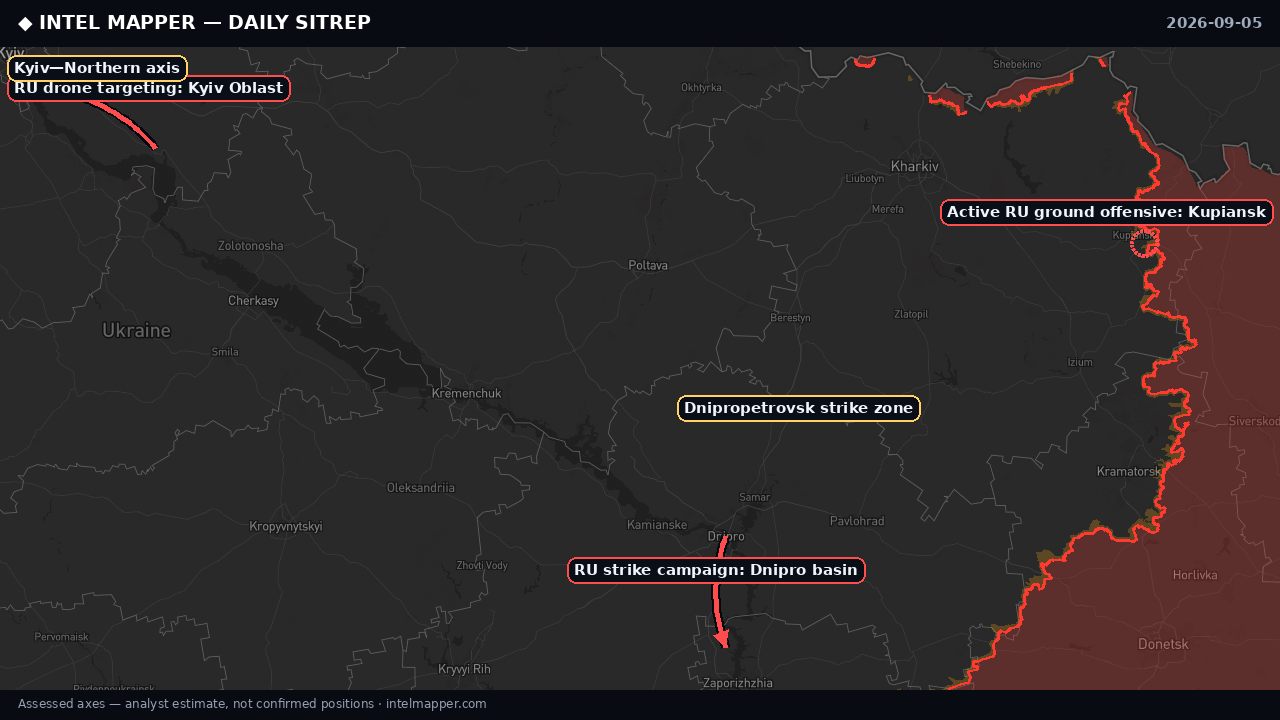
Key developments
- U.S. Navy repelled Iranian ballistic missile attacks in Persian Gulf; CENTCOM destroyed Iranian oil tankers in response, escalating direct U.S.-Iran military engagement.
- U.S. special envoys Witkoff and Kushner held Moscow talks with Putin on Ukraine ceasefire; Kremlin announced three-day airstrike pause; diplomatic opening remains tentative.
- Russia ignored Ukraine's unilateral ceasefire and continued mass overnight bombardment with 5,403 drones and 167 cruise/ballistic missiles, striking critical steel infrastructure and Kyiv targets.
- Former CIA Director Petraeus warned U.S. Gulf bases are 'no longer viable,' reflecting strategic concerns over Iranian military confidence and U.S. regional positioning.
- Ukrainian forces conducted precision strikes on Russian rear-area military infrastructure while deploying new Magura MV11 naval drone systems in Black Sea.
- Israeli forces maintained ground operations in southwestern Syria and southern Lebanon; Syrian authorities arrested former regime military officials as post-conflict stabilization continues.
- Ukraine's ceasefire proposal, delivered personally to Putin, remains unacknowledged by Russia despite U.S. diplomatic mediation and announced air campaign pauses.
Middle East 30 tracked events
The Persian Gulf witnessed direct U.S.-Iranian military confrontation on September 5, marking an escalation in regional tensions. U.S. Navy warships repelled Iranian ballistic missile attacks in the Persian Gulf near Kish Island, with all vessels successfully evading incoming fire. In response, CENTCOM disabled two Iranian oil tankers (M/T Downy and M/T Stark 1) and reportedly struck an Iranian tanker near Kharg Island with cruise missiles, causing damage and forcing crew evacuation. U.S. Defense Secretary Pete Hegseth threatened to destroy and sink Iranian oil tankers in response to further attacks, claiming capability to target all Iranian vessels in CENTCOM and Indo-Pacific areas. Iran's military command countered with warnings that attacks on U.S. naval vessels would escalate if Washington maintains its naval blockade, framing the conflict around perceived U.S. naval pressure.
U.S. intelligence assessments suggest Iran has gained confidence in its military capabilities and may leverage the Strait of Hormuz to damage U.S. and Gulf state interests. Former CIA Director David Petraeus stated that U.S. military bases in eastern Gulf states are 'no longer viable,' implying strategic vulnerability or reduced operational effectiveness. These assessments reflect concern over Iran's willingness to directly engage U.S. naval forces and use economic leverage through tanker disruption. The U.S. approved a $5.75 billion defense agreement with Saudi Arabia, likely part of broader regional containment strategy. The Trump administration is reportedly developing post-war regional strategy focused on Iran containment while expanding Israel-Arab normalization, though progress remains limited.
Israeli ground operations continued in southwestern Syria and Lebanese territory. Israeli forces infiltrated Um Bathneh village in Quneitra countryside and conducted artillery strikes on multiple positions near the Golan Heights, including Al-Rafid and Tel Baat al-Wardah, continuing occupation-era patterns. Israeli forces are preparing to reduce operations in southern Lebanon after destroying tunnels, with plans to establish a security zone 3-4 km from the Israeli border. Meanwhile, Syrian authorities arrested former Assad regime military officials, including Major General Jalal Kamel Saqr, and conducted security operations in multiple governorates. Syrian civil aviation expansion and the Hama Spring Festival opening represent post-conflict stabilization efforts, though international pressure on Israel-Syria security agreements has reportedly reduced Syrian willingness to engage.
- U.S. Navy warships attacked by Iranian ballistic missiles in Persian Gulf; all vessels evaded incoming fire. I
- Iranian state media reports U.S. cruise missiles struck Iranian oil tanker near Kharg Island in Persian Gulf.
- Former CIA Director David Petraeus states that U.S. military bases in the eastern Gulf states are 'no longer v
- Israeli military forces infiltrate Um Bathneh village in central Quneitra countryside, continuing ground opera
- Netanyahu claims he would have responded immediately to October 7 warning, stating he would have alerted IDF,
- US Presidential Envoy Tom Barrack reiterates commitment to Amman roadmap for Sweida stability. Emphasizes dial
Ukraine 30 tracked events
High-level U.S. diplomatic engagement on Ukraine escalated significantly on September 5. Trump administration special envoys Steve Witkoff and Jared Kushner arrived in Moscow from Helsinki for talks with Putin on ceasefire negotiations and undisclosed matters. The Kremlin announced Putin ordered a three-day pause in airstrikes on Kyiv during the envoys' visit, signaling a potential diplomatic opening. President Zelensky announced Ukraine's readiness to refrain from strikes on Moscow through Monday, expecting reciprocal Russian restraint on Kyiv. Ukraine's GUR Chief Budanov confirmed Ukraine proposed a ceasefire to Russia, delivered personally to Putin, covering both strikes on Ukrainian territory and frontline operations. Putin reaffirmed to the U.S. envoys a high level of Russian trust and comfort in the mediation process.
Despite diplomatic initiatives, Russia continued intensive military operations against Ukraine overnight on September 4-5. Russia conducted a mass drone and missile attack including five KN-23 ballistic missiles from Rostov and Voronezh regions and 167 Shahed and Geran drones from multiple directions. Russian strikes targeted the Kamet-Steel plant in Kamianske using ballistic missiles—Ukraine's second-largest steel producer after losses of Azovstal and Ilyich plants in Mariupol. General Staff reported 209 combat clashes across all fronts, with 55 airstrikes (187 guided bombs), 5,403 kamikaze drones deployed, and 1,702 artillery strikes. Ukraine's unilateral ceasefire order (September 5-8) was abandoned after Russia ignored it and continued overnight bombardment of Kyiv, striking Zhulyany Airport and Holosiivskyi District. Zelensky characterized these strikes as retaliatory responses to U.S. diplomatic visits.
Ukraine's air defense maintained active monitoring of ballistic missile threats and continued limited offensive operations. Ukrainian air defense reported no active strategic bombers or reactive Shahed drones in Ukrainian airspace as of the night of September 6, though ballistic missile threats from Taganrog and Rostov remained imminent. Ukrainian forces struck Russian military infrastructure, including a repair facility in Sokologirsk, Luhansk Oblast, and a MESH network relay in Zlintsi, Bryansk Oblast, using unmanned systems. Ukraine deployed its new Magura MV11 unmanned naval vessel equipped with 18 vertical-launch Wild Hornets Sting FPV interceptor drones for anti-drone capability in the Black Sea. The operational tempo reflected continued Ukrainian resistance despite intensive Russian bombardment and the fragile diplomatic pause.
- Kremlin announces Putin ordered three-day pause in airstrikes on Kyiv during preparations for arrival of U.S.
- U.S. special envoys Steve Witkoff (Trump's Middle East envoy) and Jared Kushner (Trump's senior advisor and so
- President Zelensky announces Ukraine ready to refrain from strikes on Moscow through Monday, expecting recipro
- U.S. special envoys Steve Witkoff and Jared Kushner arrived in Moscow from Helsinki for high-level diplomatic
- U.S. special envoys Steve Witkoff and Jared Kushner confirmed in Moscow for diplomatic talks with Russian offi
- Russia conducted overnight (4-5 Sept) mass drone and missile attack on Ukraine. Attack included 5× KN-23 balli
What to watch
Monitor outcomes of U.S.-Russia Moscow talks and whether the announced Kremlin three-day airstrike pause holds beyond September 8. Watch for Iranian responses to U.S. naval strikes and tanker targeting threats, particularly actions in or around the Strait of Hormuz. Track Ukrainian casualty and infrastructure damage reports from overnight Russian bombardment. Observe whether Russia resumes full-scale air operations post-diplomatic window and any formal ceasefire proposals emanating from Witkoff-Kushner engagement. Monitor Israeli force reductions in Lebanon and any developments in Israeli-Syrian security agreement negotiations. Watch Syrian stability operations targeting former regime officials and any implications for international recognition.