Iran launches ballistic missiles; Ukraine strikes Russian energy; U.S. diplomacy signals shift
Key developments
- Iran launched multiple unconfirmed ballistic missile strikes on Israel, Jordan, and Hormuz Strait targets; U.S. officials issued threat statements regarding Kazmah facility without operational specification.
- Oman rejected Iran's Hormuz toll-sharing proposal on international law grounds, undermining Tehran's regional economic leverage claims.
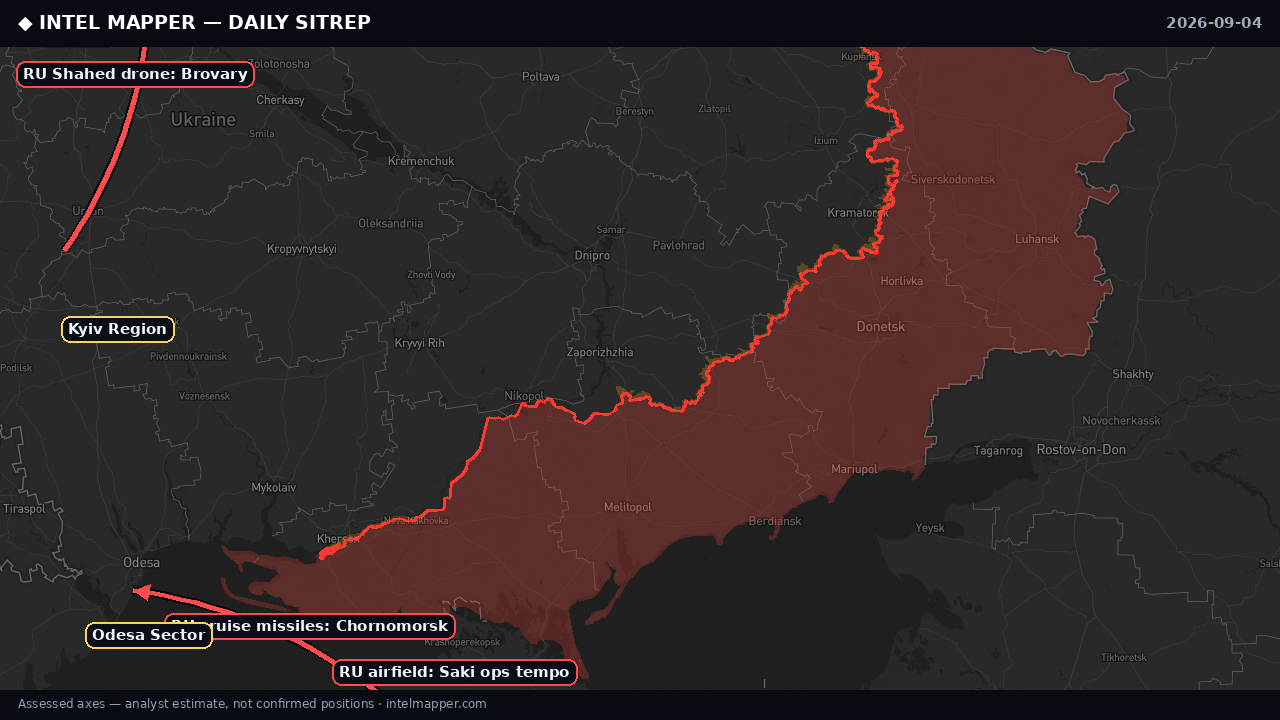
- Russian forces sustained intensive eastern Ukraine operations (207 engagements, 6,768 drone sorties) while Ukraine struck Russian energy infrastructure deep inside Russia with confirmed damage to major LNG and refinery facilities.
- Ukrainian air defense achieved 103 drone intercepts/suppressions overnight against predominantly Shahed-type systems in multi-vector attack pattern.
- U.S. envoys Witkoff and Kushner scheduled Moscow (5 Sept) and Kyiv (6 Sept) visits, signaling potential diplomatic engagement amid Ukrainian red-line statements against territorial concessions.
- Syria consolidated post-transition control through military redeployment to Hasaka, border crossing reopening with Lebanon, and landmine clearance strategy initiation.
- Israeli military established new checkpoint north of Quneitra, expanding territorial presence in southwestern Syria amid ongoing Russia-Israel military coordination statements.
Middle East 30 tracked events
Iran conducted multiple ballistic missile strikes on 4 September, reportedly targeting locations in Israel, Jordan, and the Strait of Hormuz, though impact assessments remain unconfirmed. U.S. intelligence assessments indicate Tehran perceives increased operational confidence following six months of regional conflict, believing it retains sufficient missile and drone inventories to sustain operations. This assessment contrasts with U.S. statements from President Trump claiming the U.S. has 'taken over' Iran and threatening imminent strikes on Iran's Kazmah mountain facility—rhetoric lacking operational specificity but reinforcing deterrent messaging. The escalatory cycle continues via public statements rather than confirmed kinetic engagement.
Regional diplomatic friction emerged as Oman formally rejected Iran's proposal to jointly levy charges on vessels transiting the Strait of Hormuz, citing violations of international maritime law. This rejection undermines Iranian Revolutionary Guard Corps claims of a bilateral revenue-sharing agreement and signals reluctance by regional partners to be drawn into Iran's economic coercion schemes. Separately, hardline Israeli figures including former PM Naftali Bennett proposed a non-military campaign against Qatar in coordination with Saudi Arabia, UAE, and Egypt, reflecting ongoing intra-regional tensions and bloc positioning independent of immediate kinetic operations.
Syria's post-transition consolidation proceeded through discrete institutional measures. The Syrian Army (HTS-aligned) deployed personnel to Hasaka city for the first time in ten years, signaling reestablishment of state military presence in the northeast. Senior defense and interior ministry officials conducted religious observances at Al-Guwayran Mosque in Hasaka, marking symbolic normalization. Syria announced a three-year integrated landmine clearance strategy with German technical support. Lebanon confirmed reopening of the Al-Udaidiyah border crossing scheduled for Wednesday. Israeli military established a new checkpoint north of Quneitra, expanding territorial control in southwestern Syria. Russia confirmed ongoing military-level communications with Israel regarding Syria coordination mechanisms.
- Iran launched ballistic missiles. Target and impact details remain unconfirmed. This is a follow-up report con
- U.S. intelligence assessments report Iran appears more confident after six months of conflict, believing it ha
- Oman rejected Iran's proposal to jointly charge ships transiting the Strait of Hormuz, citing international la
- U.S. President Trump claims the U.S. has 'taken over' Iran. Statement lacks specificity and appears hyperbolic
- Former Israeli PM Naftali Bennett calls Qatar an enemy and proposes a non-military campaign (public opinion, e
- U.S. President Trump states the U.S. can strike Iran's Kazmah mountain facility in the near future. No timelin
Ukraine 30 tracked events
Russian forces conducted an intensive operational tempo on 4 September with 207 recorded combat engagements across Ukraine's eastern front. Recorded Russian efforts included 59 airstrikes, 216 guided bomb drops, 6,768 kamikaze drone sorties, and 1,721 artillery and rocket strikes, concentrated primarily in the Pokrovsk sector of Donetsk Oblast. Concurrently, Ukraine's General Staff confirmed successful strikes on multiple Russian military targets including drone launch facilities near Donetsk, command posts in Fedorivka and Petrivka, and radar installations in Bobrove. Ukrainian air defense intercepted or suppressed 103 enemy drones overnight, predominantly Shahed-type systems including reactive (jet-powered) variants, plus decoy and electronic warfare assets.
Ukrainian strike operations against Russian energy infrastructure continued with confirmed damage assessments: the NOVATEK-Ust-Luga LNG facility in Leningrad Oblast sustained damage to oil pipelines (200 sq m) and primary processing units from a 1 September strike; the LUKOIL-Nizhegorodnefte refinery in Kstovo was confirmed destroyed following an 26 August strike; and a major fuel depot fire was ignited at the Lukoil facility in Adler, Sochi on 4 September with visible Russian S-400 air defense system detonation. These strikes reflect sustained Ukrainian capability to project power deep into Russian territory despite degraded air force capacity, targeting energy infrastructure that sustains Russian military logistics.
High-level diplomatic engagement signals potential trajectory shift. President Zelensky announced that U.S. envoys Steve Witkoff and Jared Kushner will visit Moscow on 5 September and Kyiv on 6 September for direct negotiations, with Ukraine guaranteeing safe passage through Russian airspace. Zelensky's chief of staff Budanov stated to the New York Times that he advised against any Donbas settlement allowing Russian flag presence over militarily uncaptured territory, indicating Ukrainian red lines in any potential negotiation framework. Russia responded via Kremlin spokesman Peskov, warning that Western-planned long-range weapons production facilities in Ukraine would become legitimate military targets, establishing conditions for escalation if negotiations proceed toward Western military assistance expansion.
- Russian drone struck Ukraine's Security Service (SBU) central headquarters on Volodymyrska Street in central K
- Ukrainian drone strike on Lukoil oil facility at Siriusss (Adler, Sochi) ignites major fuel depot fire. Russia
- Ukrainian air monitoring reports all-clear for Kyiv region. No new drone launches detected; previous air alert
- Russian forces conducted 207 combat engagements across Ukraine's eastern front on 4 September 2026. 59 airstri
- Ukrainian air defense alert: High-level ballistic missile threat overnight. Russian forces active in Bryansk a
- Two Russian reactive (jet-powered) Shahed-variant kamikaze drones transiting from Poltava Oblast toward Kyiv a
What to watch
Monitor U.S. diplomatic envoy visits to Moscow and Kyiv (5-6 September) for negotiation signals or statements indicating trajectory toward settlement discussions or escalation. Track Iranian response to U.S. threat statements regarding Kazmah facility and assess whether rhetoric escalates to kinetic action. Monitor Ukrainian energy strike campaign sustainability and Russian countermeasures. Observe Syria's border reopening implementation (scheduled Wednesday) and Lebanese-Syrian coordination development. Watch for Israeli checkpoint expansion patterns in southwestern Syria and Russian-Israeli coordination mechanism effectiveness testing.