Middle East escalates amid Gaza water crisis; Ukraine sustains drone defense as Russia advances
Key developments
- Gaza water crisis deepens as five of six desalination plants disabled by algae bloom; UNICEF reports ~1 million affected Palestinians without adequate access.
- Israel-Syria security talks collapse over Golan Heights buffer zone withdrawal; Israeli forces maintain occupation posture with military exercises and checkpoints.
- U.S. strikes in Iran and Syria produce significant civilian casualties: Kuhestak wedding strike kills ≥5, wounds 67; Damascus strike injures children; U.S. MQ-9A Reaper shot down over Humein.
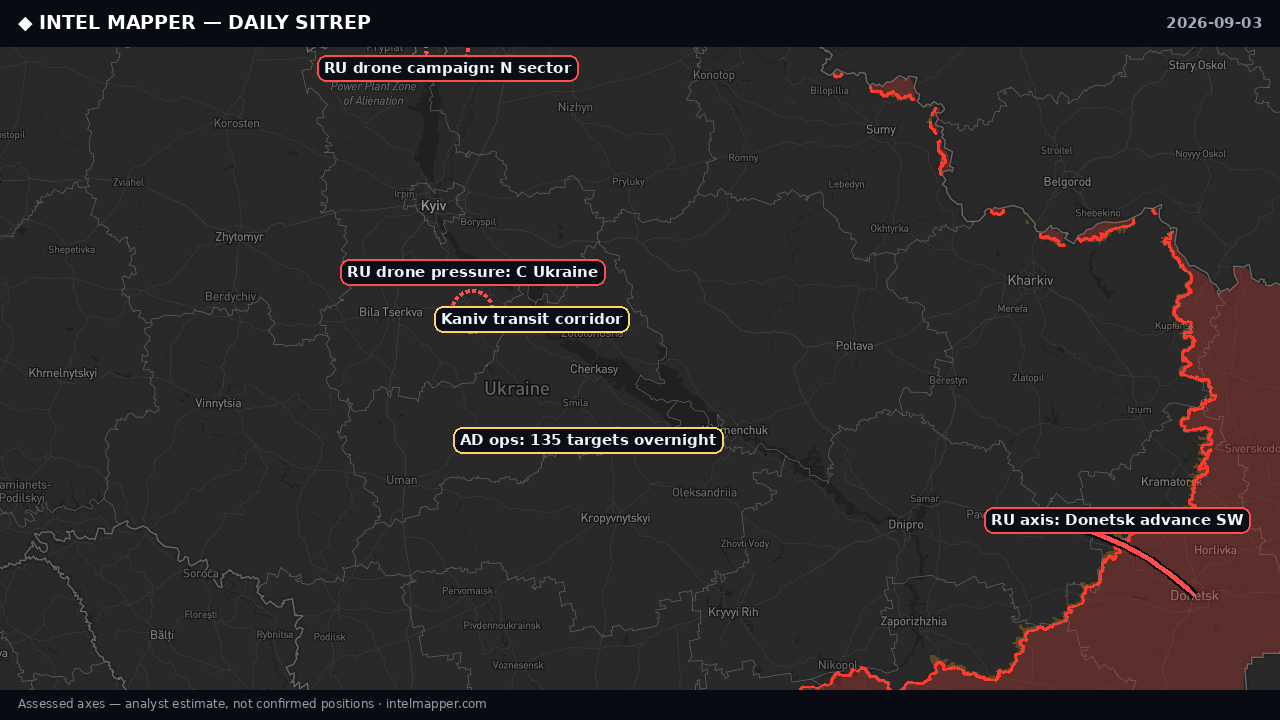
- Ukrainian air defense intercepts/suppresses 135 Russian aerial targets in 24 hours; Russian drone campaign spans multiple oblasts with port strike on Sochi.
- Russia captures Konstantynivsk in Donetsk Oblast; incremental tactical gains continue despite Ukrainian resistance and air defense effectiveness.
- Putin signals ongoing diplomatic contacts via intelligence channels while escalating public rhetoric against Western Ukraine supporters.
- U.S. Treasury warns parties to 'stay away' from Iran conflict; U.S. policy focuses on containing regional escalation amid direct military operations.
Middle East 17 tracked events
The humanitarian situation in Gaza deteriorated sharply as UNICEF reported Israel halted water supplies following an algae bloom that disabled five of six desalination plants, leaving approximately one million Palestinians without adequate water access. The bloom's origin remains under investigation, with scientists examining contributing factors. Simultaneously, the U.S. Navy flagged a critical logistics crisis, with 20 ships carrying 20,000 personnel requiring 420,000 weekly meals and 8 million gallons of fuel—reportedly constrained following Iran's destruction of the Bahrain logistics base. These parallel crises underscore the compounding strain on regional supply chains and humanitarian infrastructure.
Israel conducted military operations across multiple fronts on September 3rd. The Israeli military released footage of advanced exercises by the 210th Division along the Syria-Israel border in the occupied Golan Heights, while airstrikes targeted southern Lebanon with limited initial confirmation. Critically, Israel-Syria security talks collapsed over the Golan Heights buffer zone, with Israel refusing withdrawal from territory it deems strategically vital. Israeli occupation forces also established checkpoints in rural Daraa. These activities reflect sustained Israeli military posturing and diplomatic intransigence on territorial issues, with negotiations remaining deadlocked.
Civilian casualties mounted across the region. A U.S. airstrike on a wedding in Damascus resulted in child casualties requiring hospitalization, while a separate U.S. JSOW glide bomb strike on a residential building hosting a wedding in Kuhestak, Iran killed at least five and wounded 67—verified through visual investigation and satellite imagery. Iran's Parliament Speaker condemned the strikes, accusing the U.S. of deliberate civilian targeting. Concurrently, Kuwait reported successfully intercepting Iranian missiles and drones targeting U.S. bases, and a U.S. MQ-9A Reaper drone was shot down over Humein, Iran. These escalations suggest intensifying direct U.S.-Iran aerial operations with mounting civilian toll.
- UNICEF reports Israel halted water supplies to Gaza after algae bloom disabled five of six desalination plants
- U.S. Navy reports critical logistics crisis in Middle East: 20 ships carrying 20,000 personnel require 420,000
- Israeli airstrikes targeted southern Lebanon. Limited details available from source; further confirmation pend
- Interior Security Forces detained militia leader Alaa Zeher Al-Din at a checkpoint in rural Damascus after ide
- Israeli military released footage of advanced military exercises conducted by the 210th Division along the Syr
- Syrian activist Diaa al-Din Janah appeals to Syrian authorities to repatriate Syrian prisoners suffering from
Ukraine 11 tracked events
Russian drone operations against Ukraine remained intensive on September 3rd. Ukrainian air defense reported intercepting or suppressing 135 Russian aerial targets overnight, including 163 Shahed drones and decoy variants. Multiple drone transits were tracked across Dnipropetrovsk, Kyiv, Cherkasy, and Chernihiv oblasts, with Ukrainian naval drones striking port infrastructure in Sochi on the Black Sea. The sustained tempo of Russian UAV operations targeting civilian infrastructure demonstrates continued pressure despite Ukrainian air defenses' operational effectiveness. The breadth of drone coverage—spanning from southern Odesa to northern Chernihiv—indicates no geographic sanctuary for Ukrainian territory.
Frontline momentum shifted tactically in Russia's favor. DeepStateMAP reported the capture of Konstantynivsk in Donetsk Oblast, marking continued Russian territorial gains in eastern Ukraine. This follows weeks of incremental Russian advances in contested sectors. The loss underscores the cumulative effect of Russian manpower concentration and attrition-focused operations along the primary contact line. Ground operations remain characterized by grinding, localized advances rather than operational breakthroughs, reflecting the conflict's settled attritional character.
Diplomatic and political signaling continued despite active hostilities. Putin stated Russia maintains diplomatic contacts with Ukraine through intelligence service channels, suggesting behind-the-scenes communication persists. However, Putin simultaneously escalated rhetoric, accusing Western Ukraine supporters of becoming 'accomplices of international terrorism,' reflecting hardened public messaging. Italian Foreign Minister Tajani warned of Russian hybrid warfare and potential EU election interference, signaling concern over non-kinetic Russian activities. These divergent signals—quiet diplomacy alongside inflammatory statements—characterize the current political posture.
- Putin stated Russia maintains diplomatic contacts with Ukraine primarily through intelligence services, indica
- Ukrainian air monitoring detected 1 Russian Shahed-136 reactive drone transiting from Hubynykhy toward Magdaly
- Putin accuses Western allies of Ukraine of becoming 'accomplices of international terrorism' for remaining sil
- Italian Foreign Minister Antonio Tajani warns of Russian hybrid warfare and potential interference in EU democ
- Ukrainian naval drones struck the port infrastructure in Sochi, Russia. Attack targeted the civilian/military
- Ukrainian air defense intercepted/suppressed 135 Russian aerial targets overnight (18:00 Sep 2 – 08:30 Sep 3):
What to watch
Monitor escalation indicators in the Strait of Hormuz and Gulf region over next 48 hours, particularly Iranian response to U.S. strikes and potential missile/drone salvos. Track Israeli-Hezbollah rhetoric and operational tempo in southern Lebanon following reported airstrikes. Observe Syria-Israel diplomatic status given collapsed talks and ongoing military positioning. In Ukraine, watch for Russian exploitation of Konstantynivsk capture and potential offensive tempo changes in Donetsk. Monitor U.S. diplomatic messaging regarding Iran escalation and restraint signaling. Track any Iranian or Russian statements regarding direct U.S. military operations.