Iran-US escalation intensifies; Ukraine strikes Russian infrastructure as diplomatic efforts stall
Key developments
- US and Iran executed tit-for-tat airstrikes in escalating cycle: US struck Jiroft Airport and Bandar Abbas; Iran launched ballistic missiles and drones, claiming downing of MQ-9 Reaper drone.
- Civilian casualties reported: Iranian sources documented two killed in US airstrike on wedding ceremony; Ukrainian air strikes killed 11 in Kyiv and Kyiv Oblast including three children.
- HTS assumed formal control of Hasaka city center in northeast Syria following SDF withdrawal; Syria reopened international air service signaling normalization efforts.
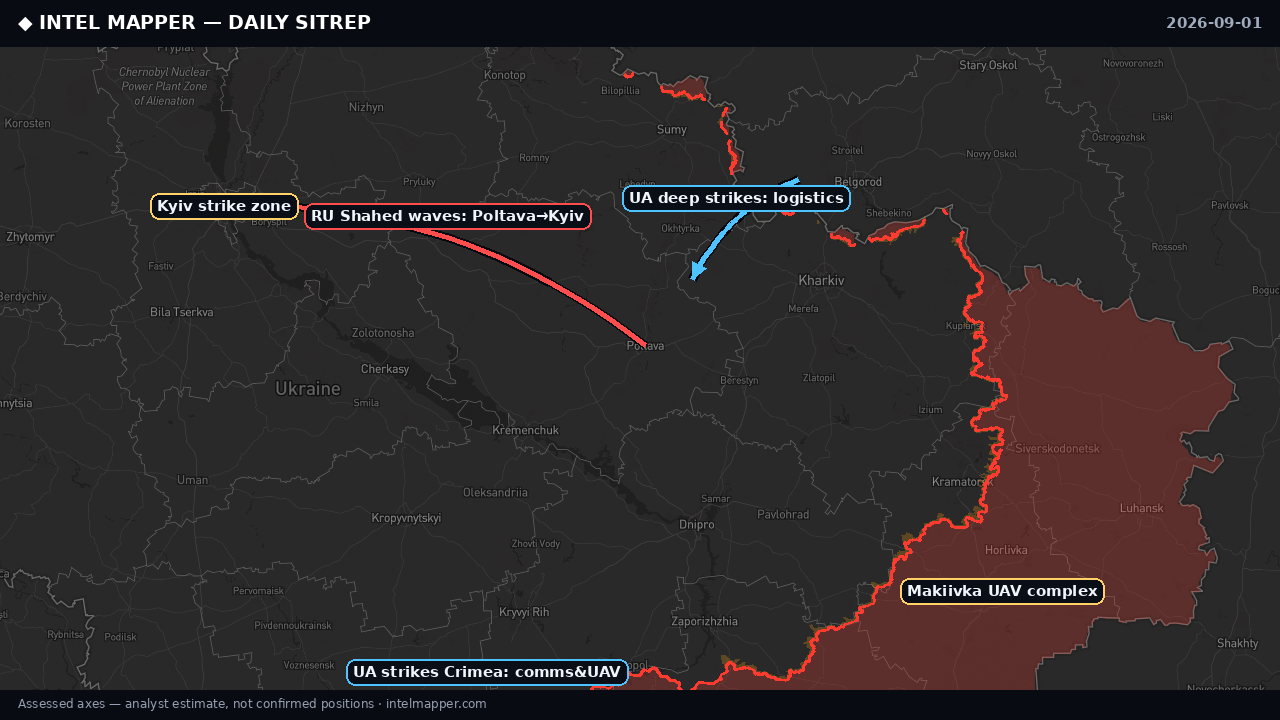
- Ukraine conducted successful deep strikes on Russian logistics, communications, and drone infrastructure in Belgorod, Zaporizhzhia, Crimea, and Donetsk while maintaining air defense against 199 Russian targets.
- Germany presented GRU evidence to NATO for Leipzig Airport sabotage; Russia ordered diplomatic evacuation from Kyiv amid anticipated escalation.
- Turkey held trilateral talks with Russia and Belarus at SCO summit while announcing Mecca Defense Alliance with Saudi Arabia and Pakistan, demonstrating multi-aligned diplomacy.
- NATO scrambled fighters responding to Russian drone incursions into Estonian and Latvian airspace; Ukrainian drones skirted Estonia-Russia border en route to St. Petersburg strikes.
Middle East 30 tracked events
A sharp escalation between the United States and Iran dominated Middle Eastern military activity on September 1st. The cycle began with U.S. airstrikes on Iranian military infrastructure near the Strait of Hormuz, including operations against Jiroft Airport in Kerman Province and Bandar Abbas port facility in Hormozgan Province. President Trump announced these operations were in retaliation for Iranian sea mines and ballistic missile attacks on a Jordan base. In response, Iran launched multiple waves of ballistic missiles and drones, reportedly targeting Jordan and regional U.S. positions. Iran's Revolutionary Guards claimed downing a U.S. MQ-9 Reaper drone over the Persian Gulf. Senior Iranian military sources threatened responses "several times greater" than U.S. strikes, warning American bases and regional interests would "quickly come under Iranian fire."
Civilian impact emerged alongside military operations. Iranian officials reported two killed in a U.S. airstrike on a house during a wedding ceremony in the Strait of Hormuz region, representing documented civilian casualties amid the tit-for-tat strikes. Nationwide air defense systems activated across Iran following U.S. airstrikes, with civil defense alerts issued and explosions reportedly occurring at the Aslawiya gas plant complex in Khuzestan Province. Israel's air defense intercepted incoming projectile(s) launched from Iran targeting Eilat, with no direct hits reported. U.S. Embassy warnings of possible flight disruptions and security risks reflected the broader destabilizing impact on regional commercial and civilian activity.
Parallel developments underlined Syria's transition and diplomatic realignment. HTS Interior Security Forces formally assumed control of Hasaka city center following SDF/PKK withdrawal, consolidating Syrian government authority in northeastern Syria. Syria reopened international flights with first commercial service from Cologne to Aleppo International Airport, signaling normalization. The IAEA reported Syria resolved outstanding safeguard issues and made progress on past nuclear activities, with approximately 73 tonnes of natural uranium documented at Syrian sites. Turkey announced formation of the Mecca Defense Alliance with Saudi Arabia and Pakistan, emphasizing regional deterrence, while Ankara held trilateral SCO talks with Moscow and Minsk, reflecting Turkey's multi-aligned diplomatic posture amid broader tensions.
- HTS Interior Security Forces formally entered Hasaka city center to assume official control following SDF/PKK
- Iran reportedly launches ballistic missiles targeting Jordan in escalatory response to ongoing U.S. military o
- Iran's Revolutionary Guards (IRGC) announced the downing of a U.S. MQ-9 Reaper drone over the Persian Gulf reg
- Iran launches ballistic missiles and drones at regional targets in escalatory response to U.S. airstrikes on I
- U.S. aircraft conducted airstrikes on Jiroft Airport in Kerman Province, Iran. This represents continued U.S.
- Senior Iranian military source via Tasnim threatens response 'several times greater' to U.S. strikes. Warns Am
Ukraine 30 tracked events
Ukraine sustained intensive Russian aerial bombardment on September 1st while continuing deep strikes against Russian logistics and communications infrastructure. Ukrainian air defense reported shooting down or suppressing 199 Russian targets during the night of August 31–September 1, including 5 Iskander-M/KN-23/S-400 systems, 5 Kalibr cruise missiles, and 187 Shahed/Geran kamikaze drones. A multi-wave Russian ballistic and cruise missile attack on Kyiv and Kyiv Oblast killed 11 people (8 in Kyiv, 3 in oblast) and wounded 17 others including three children, striking residential buildings and infrastructure. Multiple reactive (jet-powered) Shahed-variant kamikaze drones were detected transiting toward Kyiv Oblast from staging areas. President Zelensky declared Russian airspace "effectively closed," asserting Ukrainian air defense effectiveness despite ongoing pressure.
Ukrainian offensive operations targeted Russian military capabilities across multiple sectors. Ukraine conducted UAS strikes destroying Russian fuel and lubricants depots in Borisivka (Belgorod Oblast), command posts in Pologi (Zaporizhzhia), communications hubs in Mirny (Crimea), and UAV storage and launch facilities in Hvardiiske (Crimea) and Makiivka (Donetsk). Ukrainian drones transited Estonian airspace en route to striking Russian critical port infrastructure near St. Petersburg, deliberately skirting the Estonia-Russia border. These operations demonstrate sustained Ukrainian capability to project strikes into deep Russian territory and maintain pressure on Russian military logistics despite continuous Russian air campaigns against Ukrainian civilian infrastructure.
NATO and Western diplomatic responses hardened while Russian hybrid operations escalated. Germany presented evidence of Russian GRU involvement in Leipzig/Halle Airport sabotage to the NATO Council, with France, UK, and NATO Secretary General Rutte expected to support coordinated response. Polish PM Tusk condemned Russian escalation across Eastern Europe and reaffirmed continued military support to Ukraine. Russian drones crossed Estonian and Latvian airspace, prompting NATO to scramble Turkish F-16 fighters, while a Ukrainian drone briefly entered southeastern Estonian airspace. U.S. Treasury Secretary Scott Bessent delivered an ultimatum to Russian leaders: no economic relief until the Ukraine war ends. Russia ordered foreign diplomats to evacuate Kyiv, signaling anticipated intensified bombardment.
- President Zelensky declares Russian airspace is effectively closed, with no safe moment remaining for Russian
- Germany presents evidence of Russian GRU involvement in Leipzig/Halle Airport sabotage to NATO Council. France
- Turkish President Erdoğan tells Putin that Turkey-Russia relations have reached an advanced level. Both leader
- Turkish President Erdoğan, Russian President Putin, and Belarusian President Lukashenko held a trilateral meet
- Turkish F-16 fighter jets stationed at NATO's Ämari Air Base in Estonia scrambled as a Ukrainian drone briefly
- Budanov declares Ukrainian drones and missiles will dominate Russian skies for as long as Russia continues its
What to watch
Monitor Iran-US escalation trajectory over next 48 hours: threshold for direct broader regional conflict if either side interprets civilian strikes as intentional targeting. Track potential Strait of Hormuz closure impacts on global shipping and oil markets. Observe NATO formal response timeline to German GRU sabotage evidence—coordination speed may signal escalatory intent. Watch Ukrainian air defense sustainability against reported Russian ammunition abundance and potential tactical adjustments. Monitor diplomatic signaling from Turkey and Gulf states regarding de-escalation or containment efforts. Assess Syrian stability amid HTS consolidation and potential ISIS resurgence. Track any Russian direct NATO response to airspace incursions beyond fighter scrambles.